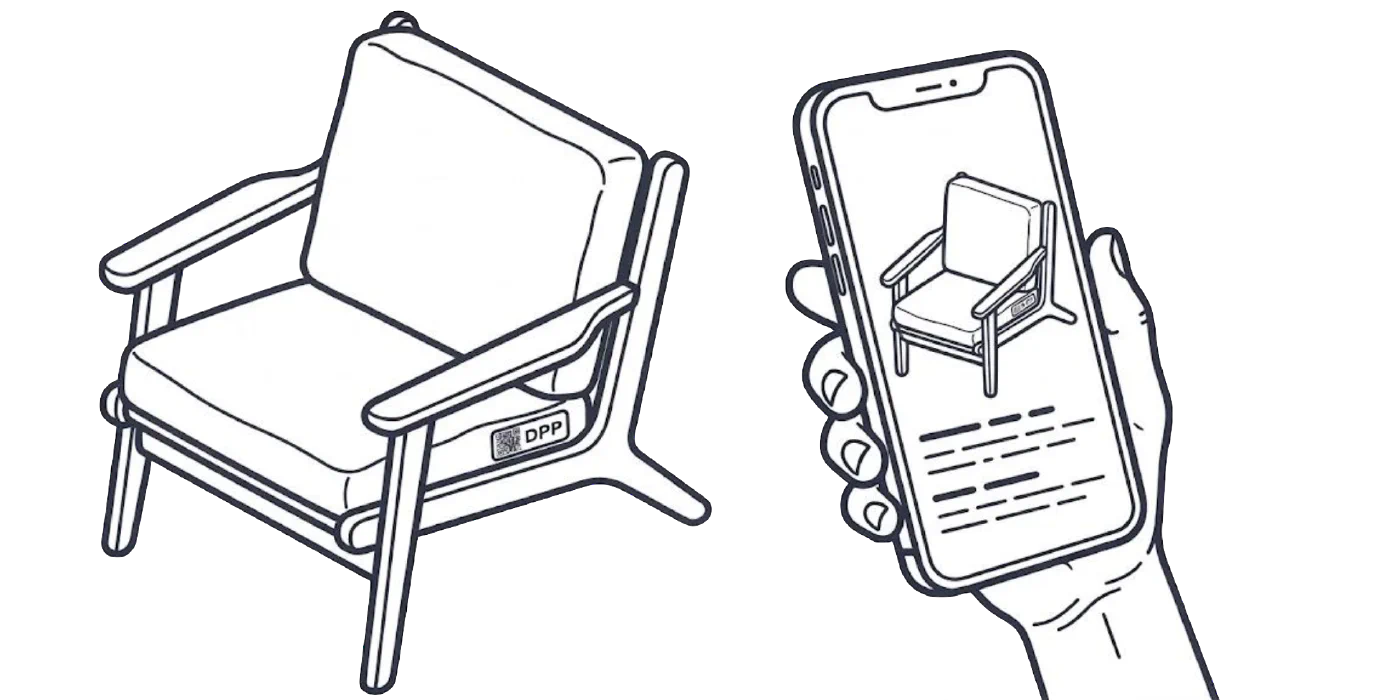
Discussions around the Digital Product Passport (DPP) in the furniture sector often center on regulatory compliance. Under the EU Ecodesign for Sustainable Products Regulation (ESPR) and the EU Deforestation Regulation (EUDR), furniture and timber products are among the first product categories for which the Digital Product Passport will become mandatory.
Yet treating the product passport purely as an administrative chore misses its biggest commercial upside: a Digital Product Passport adds a direct digital channel to the physical furniture item, connecting the customer and the manufacturer throughout the entire product lifecycle.
Whether for wardrobes, kitchens, or office furniture: pieces stay in use for many years, but the connection between customer and manufacturer is usually lost after delivery. The Digital Product Passport changes that, unlocking three tangible advantages:
1. Paperless Assembly, Care, and Provenance Documentation
Traditional furniture shipments rely on bulky paper inserts: multi-lingual assembly instructions, warranty certificates, and static care booklets. These paper packets add substantial printing and packing costs. Worse, they are frequently discarded during installation or lost by the customer, resulting in frustrating inquiries to customer service when care instructions or disassembly steps are needed years later.
A Digital Product Passport permanently links dynamic product records directly to the physical piece:
- Interactive Assembly & Disassembly Guides: Customers and professional installers access high-resolution fitting guides, animated 3D steps, and alignment tips directly on their smartphone without searching through flat-pack boxes.
- Material Provenance & Legal Compliance: Fulfills mandatory disclosures for timber species, FSC or PEFC chain-of-custody certificates, and EU Deforestation Regulation requirements in a verifiable, machine-readable format.
- Always Current Care Instructions: Keeps maintenance recommendations for surface finishes, leather care, or wood oils instantly up to date without costly reprints.
- Paperless Packaging: Significantly reduces printed paper inserts, packaging volume, and freight weight across thousands of shipments.
Real-World Scenario: Assembling a Modular Wardrobe System (Day 1)
A customer receives a three-door modular wardrobe with sliding doors, interior drawer sets, and integrated lighting, delivered in five flat-pack cartons.
- Without a Product Passport: The enclosed assembly guide is a 48-page booklet with dense, black-and-white diagrams. When aligning the doors and hinges, the customer gets stuck: the small diagrams make it nearly impossible to tell left and right parts apart. Frustrated, they call customer support or mount parts backward, leaving the doors hanging crooked.
- With a Digital Product Passport: The customer scans the discreet QR code on the inside upright of the cabinet frame. An interactive mobile guide opens immediately, featuring zoomable 3D assembly steps and a 20-second video on adjusting door gaps. The wardrobe is assembled accurately and securely, eliminating the paper pile that normally ends up in the trash.
2. Streamlined Warranty Claims and Hardware Triage
When a hinge is damaged during setup, a soft-close dampener jams, or shelf support pins are missing from the packaging, resolving the issue is notoriously inefficient. Customers struggle to describe hardware parts, take ambiguous photos, and guess at part numbers. Customer service desks spend days exchanging emails to confirm sales receipts, finish codes, and production runs before dispatching replacements.
Scanning the product passport automatically transmits the complete product context, cutting claims processing time by more than half:
- No Hunting for Part Numbers: The exact model variant, production batch, and part numbers are linked automatically, sparing customers from searching for stamped codes or serial numbers.
- Visual Claim Submission: Customers upload photos of the defect directly through the passport interface, generating a clean service ticket with just a few taps.
- Faster Turnaround: Customer support avoids time-consuming back-and-forth inquiries and can dispatch replacement parts automatically on the same day.
Real-World Scenario: Missing Hardware and Wardrobe Claim (Week 1)
While installing the interior drawers, the customer discovers that one soft-close dampener is defective and two shelf pins were missing from the hardware pack.
- Without a Product Passport: The customer sends a vague email to the retailer: “broken plastic hinge part and two metal pins missing.” The retailer asks for order receipts, photos, and the manufacturing batch code stamped on the back panel. After ten days of waiting, a package arrives containing hardware from a newer revision that does not fit the pre-drilled holes.
- With a Digital Product Passport: The customer scans the code inside the wardrobe and selects “Report Damaged or Missing Part”. An interactive exploded diagram displays every component of the cabinet. With two taps, they select the dampener and support pins. The production batch is already linked. The manufacturer verifies the claim automatically and dispatches the exact matching OEM parts that afternoon.
3. Securing Accessory Revenue and Promoting Circularity
Quality wardrobes, dining tables, and modular storage systems accompany customers for many years. Over time, living spaces change and storage needs evolve. When owners look to extend or refresh a piece years later, original invoices and exact model names are usually long gone. Without a direct link to the manufacturer, customers resort to ill-fitting third-party organizers or discard the furniture prematurely.
The Digital Product Passport establishes an enduring connection between customer and manufacturer:
- Long-Term Accessory Touchpoint: Discreetly placed inside the cabinet frame, the passport remains the first port of call for matching extra shelves, interior drawers, or replacement handles.
- Longevity Through Proper Care: Digital care guides and maintenance tips ensure that surfaces and hardware remain functional for years to come.
- True Circularity: Transparent material disclosures and dimensions simplify future repairs, handing down furniture, or secondhand resale.
Real-World Scenario: Wardrobe Expansion After Several Years (Year 4)
Four years after purchase, the owner needs more storage and wants to expand the wardrobe with two additional interior drawers and matching shelves.
- Without a Product Passport: Invoices and the exact model name are forgotten, and internal cabinet dimensions are unclear. In the retailer’s webshop, the former product line is no longer listed. Frustrated, the customer buys generic storage boxes from a third party. The manufacturer misses out on high-margin accessory revenue.
- With a Digital Product Passport: Scanning the code inside the cabinet immediately displays officially compatible accessories tailored to that exact wardrobe width. The customer orders the matching drawer inserts with two clicks. The wardrobe is upgraded, stays in service for many more years, and the manufacturer captures predictable repeat revenue.
Frequently Asked Questions: Digital Product Passports for Furniture
When does the Digital Product Passport become mandatory for furniture?
Under the EU Ecodesign for Sustainable Products Regulation (ESPR), furniture and timber-based products are listed as priority categories in the European Commission’s early working plans. Following the initial rollout for batteries and textiles (2026/2027), furniture delegated acts will establish mandatory digital passport rules. Additionally, the EU Deforestation Regulation (EUDR) already requires verifiable proof of timber origin and geolocation, accelerating the demand for digital product verification today.
Can the QR code or data carrier be integrated without ruining product aesthetics?
Yes. Furniture manufacturers have multiple discreet options that preserve design integrity:
- Laser engraving on hidden metal brackets or under tabletop edges.
- High-durability woven textile labels stitched into upholstery seams.
- Concealed RFID or NFC chips embedded directly into wood veneer or internal framing.
- High-tack QR stickers placed on the underside of chair shells, desks, or cabinet bases.
Can fitters and owners open the passport without installing anything?
Yes. The code under the tabletop or on the cabinet base is read by the camera app that is already on every phone and tablet, and the passport opens in the browser. That matters on an installation site, where a fitter assembles pieces from several manufacturers and cannot install one app per brand. It matters just as much years later, when the owner of a second-hand sideboard needs the right hinge and has never heard of the original dealer. In contract furniture, facility managers can open the record of every piece on an office floor the same way, one scan at a time.
Do dealers and refurbishers see more than the person living with the piece?
Yes, and that separation is intended. ESPR requires access to the passport to be granted by role, and it names professional repairers, refurbishers and remanufacturers as their own group next to customers and authorities; the delegated act for furniture will define the exact rights. In practice, the owner of a sofa sees assembly instructions, care advice, material declarations and recycling guidance. An authorized dealer or contract installer who signs in additionally gets joinery schematics, hardware order codes and the warranty claim form. A refurbisher preparing the piece for a second life gets the disassembly sequence and the original fabric and foam specifications. Supplier pricing and design files are simply not part of the passport, so no role can open them.
Conclusion: Transforming Furniture Compliance into a Lifetime Channel
The Digital Product Passport is far more than an EU reporting obligation; it is a permanent digital interface on every piece of furniture you manufacture. By eliminating paper waste, resolving warranty claims faster, and capturing recurring refurbishment revenue, furniture brands can turn environmental regulation into a sustainable competitive advantage.
To keep implementation straightforward and predictable, itemactive provides the turnkey, white-label platform to deploy standardized Digital Product Passports without replacing your existing ERP or PIM systems, built specifically for the operational needs of modern furniture manufacturers.