For machine builders and industrial manufacturers, the Digital Product Passport (DPP) mostly comes up as one more EU obligation, often dismissed as paperwork without a payback. Two regulations shape it: the EU Machinery Regulation, which allows digital instructions from January 2027, and the Ecodesign for Sustainable Products Regulation (ESPR), which introduces the passport one product group at a time.
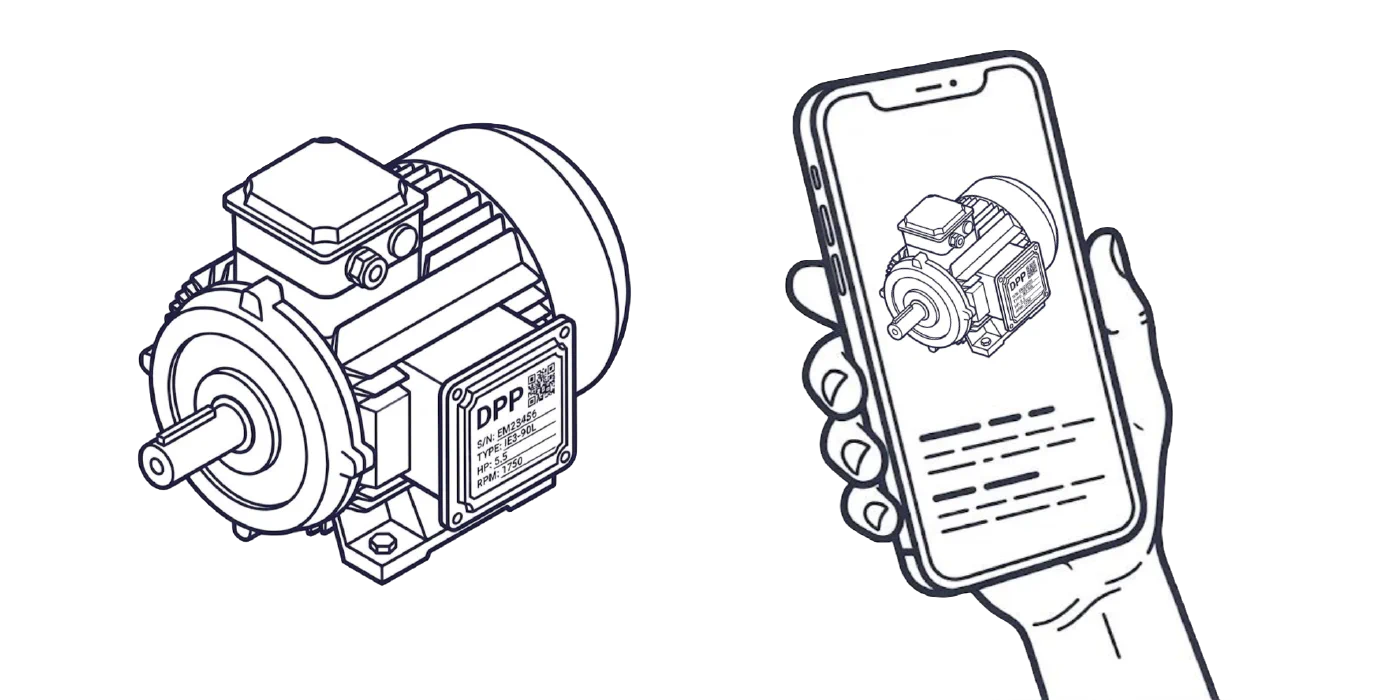
Beyond compliance, the passport also pays off in aftersales. Service and spare parts often account for most of a machine builder’s operating profit, yet once a machine passes through distributors and runs for decades, the manufacturer loses sight of it. A Digital Product Passport keeps the link alive: a QR code on the nameplate that leads to the documentation, service and spare parts for that serial number for as long as the machine runs.
In this article we follow one packaging machine through its first five years to show how a Digital Product Passport adds value: from the commissioning on day 1, to a fault in month 18, to the first spare parts order in year 5.
1. Digital Machine Documentation per Serial Number
For machine and equipment builders, printed binders are expensive to produce and easy to lose. Every customer configuration, translation and wiring change means another print run. On site, binders go missing during commissioning, end up in a control cabinet or disappear in a plant move, and every lost binder turns into a support request for an engineer.
A Digital Product Passport keeps the documentation with the machine:
- As-Built Documentation per Serial Number: Instead of a 400-page manual covering dozens of configurations, technicians see the electrical schematics, pneumatic plans and firmware versions of the machine in front of them.
- Current After Every Retrofit: When an engineering change, a field retrofit or a software update changes the machine, its records change with it, without a reprint.
- Public and Restricted Documents: Operating instructions and the EU declaration of conformity are open to everyone, while detailed schematics and service procedures require a technician sign-in.
- Less Paper, Less Freight: Binders no longer have to be printed, packed and shipped with every machine, which saves paper and transport weight on each delivery. The EU Machinery Regulation (EU 2023/1230) allows digital instructions from January 2027, with a free paper copy on request.
Document Access During Commissioning
A new packaging machine is installed on the factory floor. The technician needs wiring schematics and terminal diagrams to connect the electrical and pneumatic systems.
The printed binder has vanished, misplaced during transport or filed away in a site office. Installation stops while on-site staff contact the manufacturer’s support and wait for someone to find the right PDF files in the archive and email them over.
The technician scans the QR code on the machine chassis with a smartphone. The documentation for that exact serial number opens, including revision-specific terminal diagrams, installation guides and the EU declaration of conformity. Commissioning continues without interruption, and the manufacturer’s support is spared a routine request.
2. Faster Service and Shorter Downtime (MTTR)
Unplanned downtime costs hundreds to thousands of euros per hour. Yet service often stalls at the first step: someone has to read a faded nameplate, type a serial number correctly and describe the fault in an email, and the service desk spends the next hours on the phone working out what was meant.
A scan sends the full machine context with the request, which shortens the mean time to repair (MTTR):
- Self-Service at the Machine: Operators and maintenance staff open troubleshooting guides and fault-code tables for this model directly at the control cabinet.
- Pre-Filled Service Tickets: Model, serial number, firmware version and installed sub-assemblies are attached automatically, and the operator adds photos or error logs.
Fault Clearance During Shift Operation
On a Friday afternoon, the packaging machine halts with error code “F-304: Pneumatic cylinder pressure loss.” The packaging line stops.
While writing a support email, the maintenance technician tries to read the part number inside the housing but mistypes it. After the weekend, support processes the wrong number and ships a valve board from an older machine revision, which causes further delays.
The technician scans the QR code on the machine and sends a service request with a photo of the error display. It arrives with the exact configuration attached, so support identifies the correct component revision right away and ships the matching original part by express that same afternoon.
3. Genuine Spare Parts and Aftersales Revenue
Over 10 to 20 years of operation and several layers of distributors, manufacturers lose contact with the plant that actually runs their machine. When seals, belts or other wear parts need replacing, the maintenance manager wants them fast. If the original part number takes too long to find, they order from a generic catalog or buy a replica.
With a Digital Product Passport, the manufacturer stays one scan away:
- A Contact That Survives Owner Changes: Fixed to the nameplate, the passport stays with the machine when plant staff change, the line is relocated or the machine is sold.
- Genuine Parts Instead of Replicas: Wear parts, accessories and retrofit kits are identified at the machine and requested straight from the manufacturer. The operator gets parts that match the machine’s revision and keeps warranty claims straightforward, and the manufacturer keeps the business that replicas and gray-market parts would otherwise take.
Spare Parts Procurement During Scheduled Maintenance
After five years of operation, the packaging machine’s seals and conveyor belts are due for scheduled replacement. The new plant manager does not have the manufacturer’s sales contact at hand.
Under time pressure, they search online by approximate dimensions and order generic replicas. The cheaper replicas wear out early and cause the next unplanned stop, and the manufacturer loses the order.
The plant manager scans the QR code on the nameplate. The maintenance kit for this exact serial number appears, together with the maintenance schedule and replacement videos. One click sends an order request to the manufacturer. The manufacturer keeps the parts business, and the plant gets parts made for the machine.
Frequently Asked Questions: Digital Product Passports for Machinery
When does the Digital Product Passport become mandatory for industrial machinery?
There is no date yet, because industrial machinery is not among the priority product groups in the Commission’s first ESPR working plan. That plan covers materials and products such as iron, steel, aluminium, textiles, furniture, tyres and electronics. A passport for machinery will come with a later delegated act, and like every ESPR act it will apply at the earliest 18 months after it enters into force.
Two developments matter sooner:
- EU Machinery Regulation (EU 2023/1230): Applicable from 20 January 2027, it allows instructions to be supplied in digital form, with a free paper copy on request, and the EU declaration of conformity to be made available through a web address or machine-readable code. A passport is the natural place to publish both per serial number.
- Passports in the supply chain: Steel and aluminium are in the first ESPR working plan, so suppliers of these materials will provide passports before machine builders have to.
On top of that, larger plant operators increasingly ask for digital documentation in their tenders, before any regulation requires it.
Are component suppliers and specialized sub-contractors affected?
Yes, through the supply chain. Even manufacturers of sub-assemblies, drives, valves or hydraulics are asked by machine builders and system integrators for structured data: material composition, environmental footprint, CE documentation. Suppliers that already deliver their own passports, identified according to IEC 61406 (identification link for digital nameplates), have an advantage in vendor qualification.
Do service technicians need a vendor app on plant devices?
No, and in many plants they could not install one anyway: tablets and handheld scanners on the shop floor are usually managed by plant IT, which rarely approves a separate app for every machine supplier. The 2D code on the nameplate follows IEC 61406, which defines it as a stable link to the online information for that specific product, so any camera, industrial handheld scanner or browser can resolve it. The technician lands on the documentation for that exact serial number, including the variant and revision actually built, rather than a generic manual.
Does the DPP expose trade secrets, CAD files, or supplier pricing?
No. Beyond the data points that the delegated act for your product group makes mandatory, you decide what enters the passport, and bill of materials margins, CAD models and purchase prices have no place in it. ESPR also requires access to be regulated by role (see our complete guide to DPP stakeholder roles and access rights), with the exact rights set per product group in the delegated acts, so the information you do share reaches only the people who need it:
- Operators and plant owners: Operating manual, quick-start guide, EU declaration of conformity and end-of-life instructions.
- Certified service technicians, after sign-in: Wiring diagrams, PLC fault codes and the maintenance history of the unit.
- Market surveillance authorities: Compliance and material dossiers.
Conclusion: Turning Compliance into Aftersales Revenue
For machine builders, the Digital Product Passport is more than another EU reporting requirement. Placed on the nameplate, it connects the machine, the shop floor and the manufacturer for the life of the equipment: documentation that matches the machine as built, service requests that arrive complete, and spare parts ordered from the manufacturer instead of a replica supplier. Manufacturers that treat the code as part of the machine, not as a compliance label, turn a regulation into aftersales revenue.
To keep implementation straightforward, itemactive provides the white-label DPP platform to put passports on your nameplates without replacing your existing ERP, CAD or PIM systems.