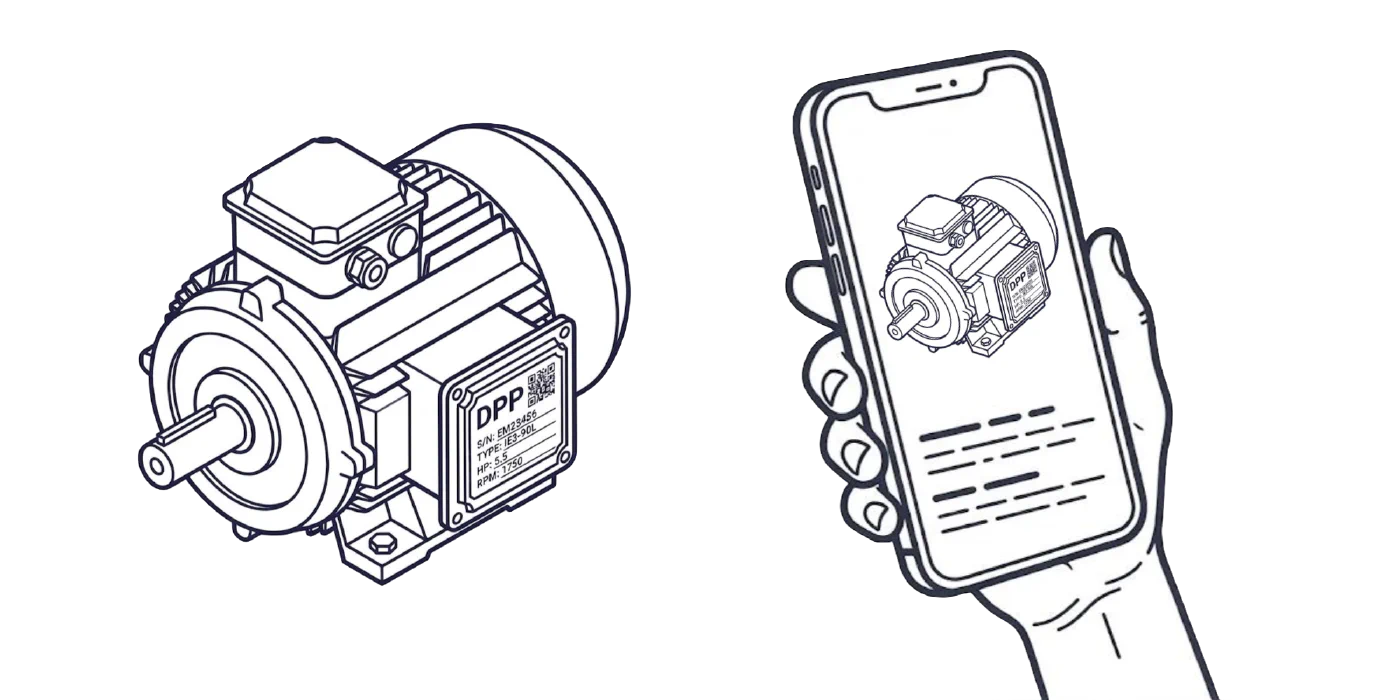
Discussions around the Digital Product Passport (DPP) focus almost entirely on EU regulatory overhead. For industrial manufacturers and machine builders, it is routinely dismissed as an expensive bureaucratic mandate.
Yet treating the DPP purely as a compliance exercise misses its biggest commercial upside: in industrial manufacturing, aftersales and service account for the majority of operating profits, and a Digital Product Passport turns the physical machine’s nameplate into a direct, lifelong digital channel between the operator and the manufacturer.
Once equipment leaves the factory floor, manufacturers often lose direct visibility across multi-tier distribution channels and multi-decade lifecycles. Connecting the physical machine directly to digital services unlocks three decisive operational benefits:
1. Sustainable On-Demand Documentation & Variant Management
For custom machine and equipment builders, traditional printed binder manuals create massive operational overhead. Every custom configuration, multi-lingual translation, and wiring update adds printing, binding, and freight costs. Worse, documentation suffers from a systemic breakdown on the factory floor: binders get misplaced during commissioning, tucked away in control cabinets, or lost during plant reorganizations, triggering routine support inquiries that tie up expensive engineering staff.
A Digital Product Passport permanently links complete machine documentation directly to the physical asset:
- Serial-Specific (“As-Built”) Precision: Instead of generic 400-page manuals covering dozens of machine configurations, technicians access the exact electrical schematics, pneumatic plans, and firmware versions tied to their specific serial number.
- Always Current & Retrofit-Ready: Replaces static paper with dynamic digital records. When an engineering change order (ECO), field retrofit, or software update occurs, records reflect immediately without reprinting.
- Role-Based Data Protection: Public documents (operating instructions, CE declarations) remain openly accessible, while proprietary electrical schematics and service tiers require authenticated technician login.
- Paperless Efficiency & Compliance: Fully aligns with the digital documentation provisions of the EU Machinery Regulation (EU 2023/1230) and ESPR, eliminating physical binder logistics and paper waste.
Real-World Scenario: Document Access During Commissioning (Day 1)
A new packaging machine is installed on the factory floor. The technician needs wiring schematics and terminal diagrams to connect electrical and pneumatic systems.
- Without a Product Passport: The printed binder has vanished, misplaced during transit or filed away in a back office. Installation grinds to a halt while on-site staff contacts manufacturer support, waiting for an agent to retrieve the correct PDF files from the archive and email it over.
- With a Digital Product Passport: The technician scans the QR code on the machine chassis with a smartphone. The complete documentation tied to that specific serial number opens instantly, including revision-specific terminal schematics, installation guides, and the CE declaration of conformity. Commissioning proceeds without interruption, and manufacturer support is spared a routine request.
2. Streamlined Service Workflows & Faster MTTR
In industrial manufacturing, unplanned machine downtime costs hundreds to thousands of euros per hour. Yet the service resolution process frequently stalls at step one: field operators manually deciphering faded nameplates, mistyping serial numbers, and submitting vague emails, which forces manufacturer service desks into time-consuming telephone tag.
Scanning the Digital Product Passport transmits complete, error-free machine context, dramatically reducing Mean Time to Repair (MTTR):
- Targeted Self-Service at the Machine: On-site maintenance crews and machine operators pull up model-specific troubleshooting trees and fault-code guides directly at the control cabinet for rapid first-line resolution.
- Pre-Populated Service Tickets: Critical machine metadata (including exact model, serial number, firmware revision, and installed sub-assemblies) attaches automatically without manual typing, while operators upload photos or error logs directly to the ticket.
Real-World Scenario: Fault Clearance During Shift Operation (Month 18)
On a Friday afternoon, the machine halts with error code “F-304: Pneumatic cylinder pressure loss.” The packaging line stops.
- Without a Product Passport: While writing a support email, the maintenance technician tries to read the part number inside the housing but mistypes it. After the weekend, support processes the incorrect number and ships a valve board from an older machine revision, causing further delays.
- With a Digital Product Passport: The technician scans the QR code on the unit. The exact equipment configuration loads automatically. They select the pneumatic sub-assembly, attach a photo of the error display, and submit the ticket in one click. Support immediately identifies the correct component revision and dispatches the exact genuine part via express shipping that same afternoon.
3. Defending High-Margin Aftersales & Spare Parts Revenue
Across multi-tier distributor networks and 10- to 20-year equipment lifecycles, manufacturers routinely lose direct contact with the actual plant operator. When wear parts, seals, or consumables require replacement, maintenance managers prioritize speed over brand loyalty. Unable to quickly identify the original part number, they default to generic distributor catalogs or gray-market replicas.
The Digital Product Passport restores a direct commercial bridge between the operator and the manufacturer:
- Lifelong Touchpoint Across Second & Third Owners: Permanently mounted on the machine’s nameplate, the passport remains an enduring service touchpoint even when plant personnel change or machines are relocated.
- 1-Click Genuine Spare Parts Reordering: Wear parts, verified accessories, and retrofit kits are identified directly at the machine and requested straight from the manufacturer to protect high-margin aftersales revenue and safeguard warranty compliance.
Real-World Scenario: Spare Parts Procurement During Scheduled Maintenance (Year 5)
After five years of continuous operation, the machine’s seals and conveyor belts are due for scheduled replacement. The new plant manager does not have the original manufacturer sales contact on hand.
- Without a Product Passport: Under time pressure, they search online by approximate dimensions and order generic third-party replicas. The low-cost parts wear out prematurely, and the manufacturer forfeits €2,000 in high-margin aftersales revenue.
- With a Digital Product Passport: The plant manager scans the QR code directly on the nameplate. The official maintenance kit for that exact machine serial number is displayed immediately. With one click, they submit an order inquiry directly to the manufacturer, complete with maintenance schedules and video replacement guides. The manufacturer captures high-margin aftersales revenue, and the customer ensures warranty-backed reliability.
Frequently Asked Questions: Digital Product Passports for Industrial Manufacturers
When does the Digital Product Passport become mandatory for industrial machinery?
The regulatory framework affects machine builders through two converging European regulations:
- EU Machinery Regulation (EU 2023/1230): Fully applicable from January 20, 2027, it explicitly recognizes digital operating instructions and digital EU declarations of conformity, permitting manufacturers to replace printed paper documentation under defined criteria (such as digital accessibility and paper copy on request).
- Ecodesign for Sustainable Products Regulation (ESPR): While the earliest delegated acts (2026/2027) focus on batteries and textiles, industrial machinery, motors, and electronics follow in priority waves.
However, the commercial catalyst precedes both deadlines: Tier-1 plant operators, enterprise buyers, and international EPC contractors are already writing digital documentation and DPP readiness into procurement tenders to secure their own supply chain compliance.
Are component suppliers and specialized sub-contractors affected?
Yes, via the supply chain cascade effect. Even if an industrial manufacturer produces specialized sub-assemblies, hydraulics, drives, or sensor assemblies rather than turnkey production lines, machine manufacturers require verifiable, machine-readable data (material composition, environmental footprint, CE documentation). Suppliers that deliver digital sub-assembly passports compliant with standards like IEC 61406 (identification link for digital nameplates) secure a significant competitive edge during vendor qualification.
Do service technicians need a vendor app on plant devices?
No, and in many plants they could not install one anyway: tablets and handheld scanners on the shop floor are usually managed by plant IT, which rarely approves a separate app for every machine supplier. The 2D code on the nameplate follows IEC 61406, which defines it as a stable link to the online information for that specific product, so any camera, industrial handheld scanner or browser can resolve it. The technician lands on the documentation for that exact serial number, including the variant and revision actually built, rather than a generic manual.
Does the DPP expose trade secrets, CAD files, or supplier pricing?
No. Beyond the data points that the delegated act for your product group makes mandatory, you decide what enters the passport, and bill of materials margins, CAD models and purchase prices have no place in it. ESPR also requires access to be regulated by role, with the exact rights set per product group in the delegated acts, so the information you do share reaches only the people who need it:
- Operators and plant owners: Operating manual, quick-start guide, EU declaration of conformity and end-of-life instructions.
- Certified service technicians, after sign-in: Wiring diagrams, PLC fault codes and the maintenance history of the unit.
- Market surveillance authorities: Compliance and material dossiers.
Conclusion: Turning Compliance into a High-Margin Growth Engine
The Digital Product Passport is far more than an environmental reporting requirement; it is a permanent digital bridge between the machine, the shop floor, and the manufacturer. By eliminating costly binder logistics, automating first-line service triage, and securing recurring spare parts orders directly at the asset, industrial manufacturers can convert a regulatory mandate into a self-funding competitive advantage.
To ensure deployment remains lean and low-risk, itemactive provides the turnkey, white-label infrastructure to roll out standardized Digital Product Passports without overhauling your existing ERP, CAD, or PIM landscape, purpose-built for the operational realities of machine and equipment manufacturers.